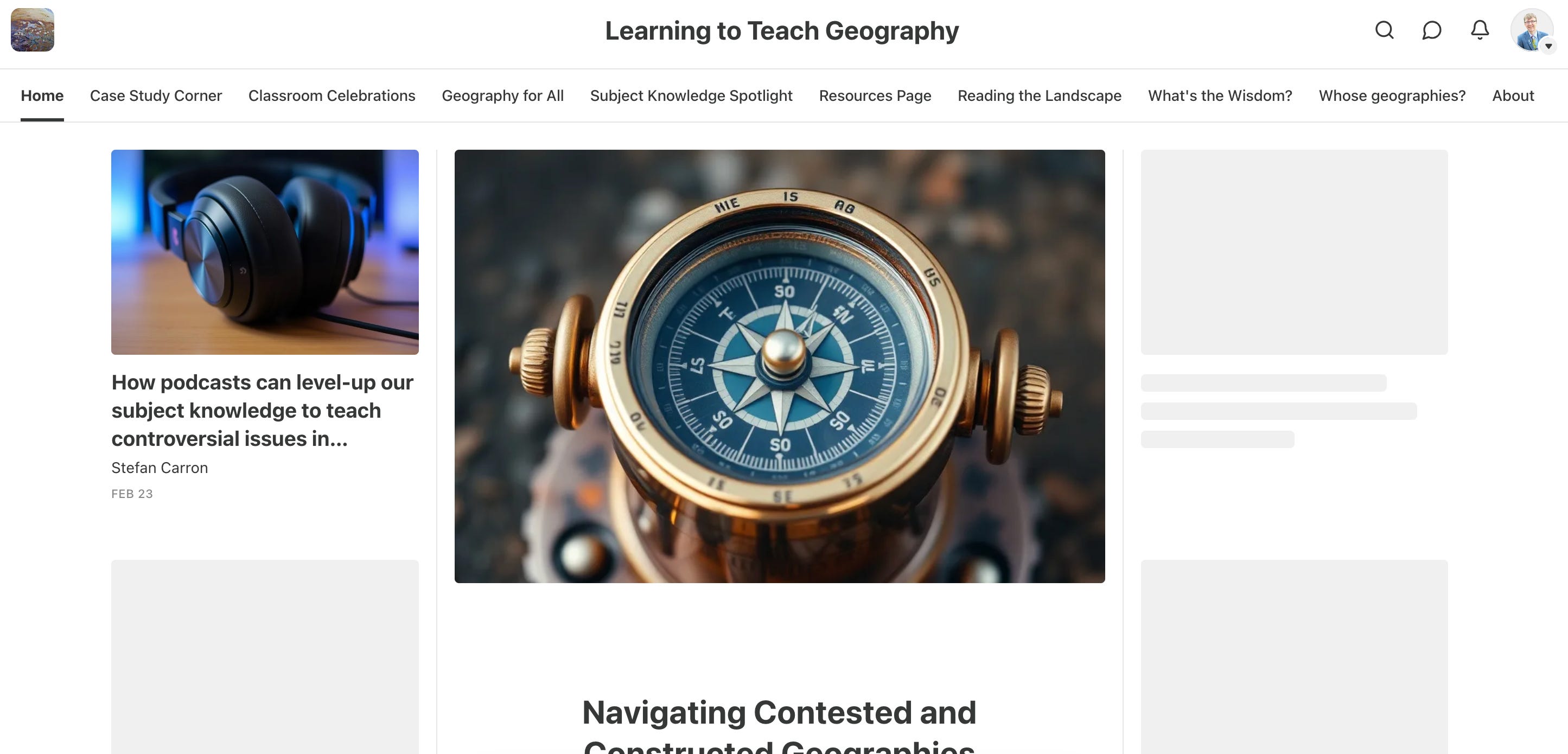
David Preece shared the news of a new collaborative Substack, called Learning to Teach Geography.
He said on LinkedIn:
We’re building a diverse, democratic and supportive space to curate great ideas for early career geography teachers – and we want new authors, trainees, and all kinds of teachers to contribute. We believe that submitting work for publication is as much about the learning process as the final publication. You’ll get supportive advice and guidance from the editorial team, and coaching and help if you are new to writing. We’re happy to take submissions from multiple authors, and ensure that you can get the opportunity to write.
The first few posts have now been added to the Newsletter.
There are several sections to the newsletter, and contributions are welcome on the following topics.
- What's the Wisdom On?
- Thinking like a Geographer
- Reading the Landscape
- Help! I'm lost…
- Case Study Corner
- Subject Knowledge Spotlight
- Fieldwork Focus
- Whose geographies are we teaching?
- Geography for all
- Finding your way
- Classroom Celebrations
Why not make a contribution?
What can I write about?What’s the Wisdom On? (1250-2000 words)
A short guide to a particular aspect of geography teaching, providing an overview and summary of the reading and evidence from practice-based professional thinking. It is likely to include some references and reading recommendations.
Reading the Landscape (1000-1250 words)
Short article reviewing current reading and thinking, or key articles from the geography teaching library.
Help! I’m lost… (500-750 words)
A problem page for trainee teachers and mentors, offering practical help from a panel of writers to anyone involved in training new geography teachers.
Case Study Corner (750-1250 words)
A short article helping you to get to grips with the key knowledge and approaches required to teach a case study example. You may want to include some links, resources or connections to ideas.
Subject Knowledge Spotlight (1000-1500 words)
A short overview to key subject knowledge areas; sharing the key things you need to know, and how you can upskill yourself for teaching it for the first time.
Fieldwork Focus (750-1250 words)
Helping you to understand the key ideas and skills for fieldwork topics. Includes alternatives to fieldwork that you can do in the classroom.
Whose geographies are we teaching? (1000-1500 words)
A review and discussion piece, considering a key issue of diversity, equity and inclusion in the geography classroom and curriculum, presenting ideas and key reading.
Geography for all (1000-1500 words)
A review and discussion article, considering key issues facing students in underserved or under-represented communities in geography, ensuring that high quality geography is available to all.
Finding your way (750-1250 words)
A step by step guide to tackling a particular teaching issue in the geography classroom.
Classroom Celebrations (500-1000 words)
A time to shine a light on brilliant work and quick ideas, displays or examples from real teachers classrooms. This is likely to include photographs or examples from your classroom – so please do see the notes about what and how you can include those!
Thinking like a Geographer (1000-1500 words)
A Geographical opinion on educational issues.
It's a good way to get your work out there and start contributing to the subject community.
Comments