The 14th of July sees a field based workshop for ‘A’ level teachers organised by the RGS. The cost is an excellent £5 (or just £3 for members) and it looks like being a fantastic event. If I wasn't already doing something else that day I would definitely be going along to the event.
This one-day workshop is designed to introduce A Level teachers to new ways of explaining changing places with a particular focus on connections between people, the economy, and the ways that infrastructure(s) link the local, national, and international scales.
Led by academics based at the Bartlett Centre for Advanced Spatial Analysis (CASA) at University College London, we will explore topics including:
How you can understand neighbourhoods and cities as complex systems (which gives you new ways to think about economic change and social inequality).
How you can use fieldwork to ground these ideas in practical questions of past and present connections, and shifts in the flows of people, resources, money and investment.
How you can put these two strands together to create simple simulations of residential gentrification and discrimination, and how simulations of urban phenomena can be used to generate hypotheses about how cities work.
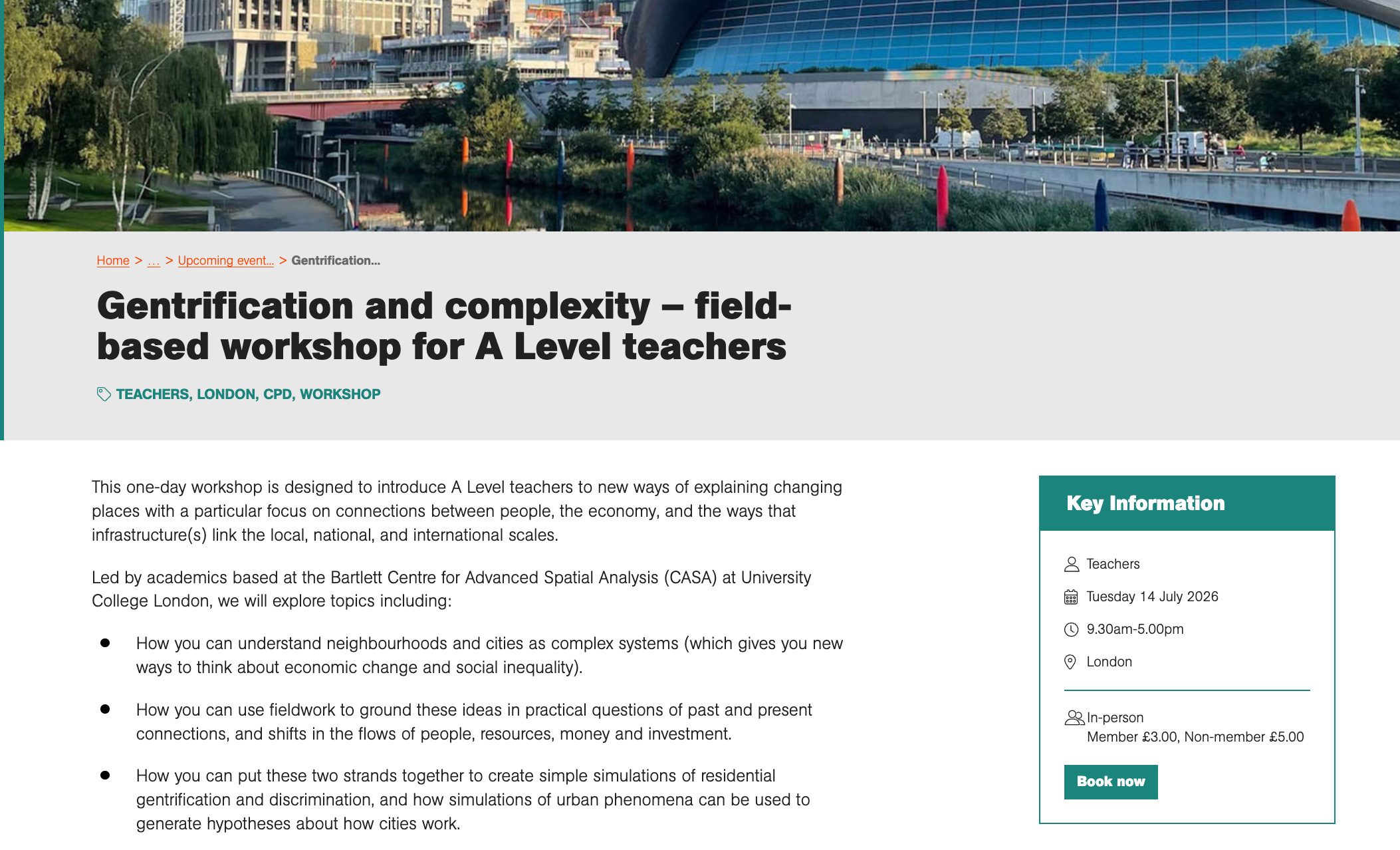
We will be based at UCL’s new Stratford campus in Queen Elizabeth Olympic Park. On the day, you will be taken on a guided tour of the Park and nearby neighbourhoods including Stratford and Hackney Wick, exploring the history of the area and how and why it has changed over the past 150 years.
This will be followed by a series of workshops and include a discussion about Memory Mapper – a free digital participatory mapping tool developed at CASA – to explore and explain what we encounter in the field.
The workshop and accompanying resources are designed to support teaching of the A Level curriculum, including skills that could also be employed in preparation for the NEA. The skills and techniques that will be introduced during the day can also be used in other fieldwork locations.
Comments